FAQ
Questions regarding the deployment and use of EV charging light poles
Nowadays, more and more charging stations are being added. However, this high number results in visibly more crowded public spaces, and their production, transport, installation, and management also cause additional CO₂ emissions.
The CityCharge powered EV charging light poles counteract this. You can read exactly how we do that and what is involved on this page.
Frequently asked questions bundled
Would you prefer our most frequently asked questions bundled in one document? Download our Q&A here.
Frequently asked questions about our smart charging strategy
Is charging an EV via a charging light pole actually advantageous?
Yes. The rates are comparable to regular charging stations. The difference lies in installation costs, grid connection, the purchase price of electricity, and the operating period. These variables determine the charging price at the charging point, regardless of whether it concerns a charging light pole or a regular charging station. The additional benefits: up to 58% CO₂ savings, no additional objects in public space, and optimal load balancing across multiple charging points thanks to one combined grid connection for maximum energy distribution across all charging points.
What is the status of the rollout of charging light masts regarding the provincial concession?
The Netherlands has a number of large concession contracts for EV charging, which often focus solely on the rollout of standard charging stations – not on new or alternative ‘charging objects’. Consequently, municipalities sometimes mistakenly believe that charging light poles are not permitted. However, every concession includes two important exceptions:
- Innovation clause: municipalities may always deploy innovative charging objects.
- Provincial concessions apply only to regular charging stations on a grid connection of max. 3x35A. This is the standard grid connection to power 1 regular charging station (2 charging plugs). However, charging light poles are connected in series in larger numbers in a street to a single grid connection of greater than 3x35A, 3x50A, 3x63A, or 3x80A, depending on the number of charging light poles. This means that the current provincial concessions do not apply to the rollout of charging light poles in their current form.
What does a municipality need to organize to make this possible?
Municipalities must include ‘innovative charging objects’ in their EV charging strategy and allow EV charging points to be integrated into a number of lampposts within the municipality. Via the Quick Scan at www.citycharge.eu/quickscan, every municipality in the Netherlands can see how many lampposts are already in the right location (between two parking spaces and on the street side) and where the potential is greatest.
Based on the current concessions, every municipality in the Netherlands has the right to independently start installing EV charging light poles. See the example of the municipality of Zevenaar above.
Who pays for the investment in the rollout of charging light poles?
The CPO finances the hardware and installation. The municipality facilitates the locations. CityCharge works with all CPOs and is OCPP-certified and accredited by the Open Charge Alliance (OCA).
Is the concept still in pilot status?
No. The system is technically ready and already in 32 municipalities in the Netherlands, including Eindhoven, Alkmaar, Haarlemmermeer, Arnhem, Oosterhout, Zaltbommel, Renkum, Eemsdelta, Zwolle, Deventer, and Tilburg. In addition, many municipalities are scheduled for implementation in the Netherlands and in France (Lyon, Paris, Lille), Belgium (Flanders), and the UK.
How many Dutch municipalities are already using these charging light masts?
As of January 2026, 32 municipalities are using CityCharge charging masts. Ranging from Eindhoven, Alkmaar, Haarlemmermeer, Arnhem, Oosterhout, Zaltbommel, Renkum, Eemsdelta, Zwolle, Deventer, and Tilburg.
How is CityCharge financed (long term)?
CityCharge has two external shareholders: Purso (Finland) and the public development agency OostNL (funded by the Ministry of Economic Affairs and the provinces of Gelderland and Overijssel).
Is the rollout of charging light masts more expensive than regular charging stations?
The costs are comparable, but the connection process differs. A standard charging station is typically connected to a 3×25 Amp grid connection. This is the most cost-effective connection for a CPO. The majority of these connection costs are borne by the grid operator, not the CPO. However, providing a separate 3×25 A grid connection every 40 meters for a CPO is not feasible for grid operators in the Netherlands from a grid congestion perspective. Therefore, multiple charging light poles are connected to just one (heavier small-scale consumer) grid connection. Through mutual load balancing, energy is efficiently distributed among the charging light poles. The costs of the heavier connection (to increase charging speed) are borne by the CPO, as are the costs for the cabling between the light poles. All in all, a shift of part of the costs takes place from the grid operator to the CPO. However, by connecting multiple charging light masts to a single existing grid connection and upgrading it, the CPO gains a time saving of 6-9 months, allowing the charging light masts to become operational sooner.
Is the charging light pole more expensive than a normal light pole?
The charging light mast is slightly more expensive than a regular light mast due to the triple insulation, the 2 service hatches, and the extra internal rigidity.
What do the NAL and NKL think of this concept?
Although charging light poles have been used in the Netherlands since 2021 and are now in use in more than 32 Dutch municipalities, knowledge about them among policymakers is often still rudimentary. This is because, until now, provincial concessions did not specify these types of ‘unconventional charging objects,’ but only the standard, regular charging station.
Knowledge Centre E-Laad has also issued a positive recommendation regarding this and certified the concept; however, since the charging light poles are placed ‘behind’ the smart meter in a charging street or charging plaza configuration, this concept formally falls outside their scope.
As part of the ‘reframing’ approach, a consensus is now emerging regarding the application of charging light mast projects throughout the Netherlands, and ‘charging light masts’ are explicitly mentioned as such in tenders (such as the recent SGZH 3 South Holland tender and the NAL East market consultation).
What about the charging rate at a charging light pole?
The CPO determines the charging rate. This is because the CPO also installs the charging light poles and the installation at its own expense and risk. In provincial concessions, conditions are often set regarding the level of charging rates. This can vary based on the purchase price of electricity, the duration of the concession (how many years to recoup the investment), and usage.
Does the road surface need to be marked to indicate that it is a charging spot?
No. There is no traffic regulation for this charging station that mandates markings on the road surface. However, it can clarify the recognizability of the potential charging station.
Can every CPO collaborate with CityCharge for the installation of charging light poles?
Yes. CityCharge is a neutral hardware manufacturer of the smallest AC charger (22 kW) that can be integrated into a lamppost. CityCharge is currently collaborating with 9 different CPOs on projects and supplies ‘white labeled’ hardware to CPOs so that they can apply their own name, charge ID, service phone number, and marketing to it.
Can every municipality collaborate with CityCharge for the installation of charging light poles?
Yes, every municipality is free to collaborate with CityCharge, and CityCharge appreciates any initiative to that end. It often starts with a ‘pilot’ street featuring a number of charging lampposts to see how operation, usage, and acceptance proceed in the street or neighborhood. Following an evaluation, this may or may not be scaled up.
Can EV charging and public lighting be combined?
Yes. There is sufficient space in a lamppost to safely accommodate both the cable for public lighting and the cable for the EV charging point side by side. The charger is located at a height of approximately 1.20 meters; depending on the type of lamppost, the fixture is situated at 4, 6, or 8 meters. However, this does require a lamppost with a special hatch for the charging unit. Therefore, municipalities often replace the existing post with a charging lamppost and reuse the old post elsewhere in case of damage or replacement (as the lifespan is at least 40 years). This creates a fully circular solution without purchasing new materials.
How is the installation responsibility organized?
The municipality is responsible for the installation. Moreover, the municipality is and remains the owner of the lampposts and public lighting and must therefore permit the installation of a charging point in a lamppost. The CPO is responsible for the charging point. In many cases, the SLA agreements for public lighting (service and management by the contractor) are combined with the contractor managing the EV charging unit. From the perspective of efficiency and communication, this is the most ideal situation.
Is the charging light pole available in every shape and color?
Yes, the charging light pole is available in all common sizes and shapes, including RAL colors, making it suitable for any public space.
Is the EV electrical connection on the same grid connection as the public lighting?
No. A standard light pole operates at 6 amperes, which is insufficient for EV charging. Therefore, a new, heavier connection is installed for a charging light pole – comparable to a standard charging station. For safety reasons, grid operators require one grid connection per pole (two cables can cause confusion for the technician). The new connection powers both the lighting and the EV charging unit.
Is it technically permitted by Knowledge and Innovation Centre ElaadNL?
Yes. The CityChargeR solution is located behind the smart meter, which is often housed in an existing charging station, street cabinet, or manhole. A CityChargeR charging light pole is currently featured on ElaadNL’s demo charging plan at Cleantech Park Arnhem and is being deployed in 32 Dutch municipalities.
Is the installation of charging light masts more complicated than regular charging stations?
In principle, no. Installing the charging light mast is identical to installing a regular light mast. The difference lies in the installation of the grid connection (compared to a regular fuse box, there is now a connection box with 2 separate RCDs and the interconnection of the charging light masts).
Is the EV charger in the charging light pole powered by a separate mains connection?
Netbeheer Nederland advises one grid connection per (charging) light pole and splitting this at the charger level, between the charger and the light point at the top of the charging light pole. This is for safety reasons for the Netbeheer-part installer.
Are two grid connections permitted on the charging light mast, or must it be one combined grid connection?
Yes. It is permitted; some municipalities in the Netherlands also prefer to keep both power supplies separate (technically, there is no preference), but Netbeheer Nederland prefers one connection in the charging light pole that powers both the charging point and the public lighting.
Can you charge and pay at a charging light pole with any charging card?
Yes. All CityChargeR units are connected to the CPO’s backend, through which charging transactions take place. EV drivers receive a bill via the CPO. From 2026, payment by debit or credit card will also be possible. In that case, billing will take place directly via the bank account/credit card.
Can you charge and pay with a debit/credit card at a charging station?
Yes. From 2026, payment by debit or credit card will be possible at the charging station, in addition to the current standard RFID charging cards. For debit and credit card transactions, settlement takes place directly via the EV driver’s bank account/credit card. This functionality will be introduced in Q1 2026.
Frequently asked questions about grid congestion
Up to what kW can charging light poles charge
The EV charging unit installed in the lamppost is an AC charging unit. It delivers up to 22 kW (32 A). Functionally, the EV charging unit is identical to a regular standalone charging station, but much smaller in volume. Due to the integration into lampposts, multiple lampposts can be implemented in a row along a street. Rule of thumb here:
- 2 CityChargeR charging light masts are connected to 3×35 A,
- 4 CityChargeR charging light masts are connected to 3×50 A and
- 6 CityChargeR charging light masts are connected to 3×80 A.
What are the differences regarding grid congestion?
Standard charging stations typically use a single 3x25A connection (concession conditions). This is the most cost-effective low-consumption connection for powering two EVs simultaneously. Therefore, four standard charging stations will each receive their own 3x25A connection. This is far from optimal due to grid congestion and the grid operator’s installation capacity, as the power is distributed between two sockets.
Frequently asked questions about cluttering of the streetscape
What are the advantages of a charging light pole compared to a regular AC charging station?
- No cluttering of public space, because the charging point is integrated into the lamppost.
- A CO₂ reduction per location of up to 58%, through reduced raw material use, transport, and maintenance and management (independently demonstrated by Climate Impact).
- Energy distribution takes place across many more charging points than in a standard charging station configuration. As a result, load balancing can be implemented many times more efficiently than on a single charging station with only 2 charging points.
- Charging light masts are easy to connect to existing charging stations.
- Possibility to reuse existing lampposts at other locations in the municipality where a lamppost has been damaged (and therefore a new one does not need to be ordered and installed = circular solution).
Is an environmental permit required for a charging light mast?
No. The lamppost is and remains the property of the municipality; only a second function is being added. It therefore remains a lamppost, and no environmental permit applies to it.
Is marking a parking space and making a traffic decision at a charging light pole mandatory?
No, the marking of ‘charging spots’ is at the discretion of the municipality and the CPO and is subject to a municipal traffic decree. Interested parties (local residents) may object to this traffic decree.
Does a separate sign need to be added indicating that it is a charging spot?
No, see question 29 above.
What is the impact on the cluttering of public space?
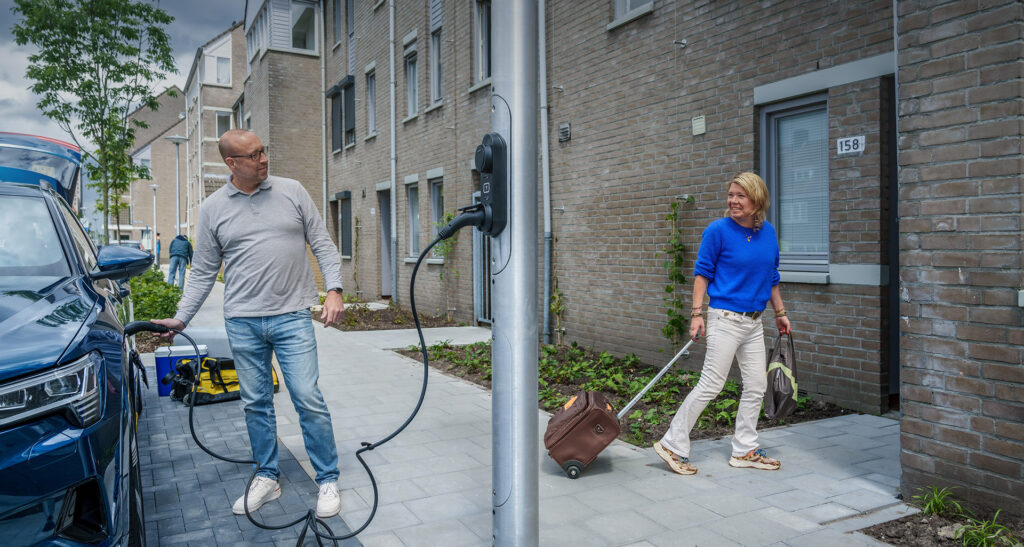
By integrating 2 objects into 1 (EV charging point in the lamppost), this results in no additional objects in the street.
CityCharge is of the opinion that all additional traffic signage is also superfluous and that making traffic decisions may become unnecessary for the municipality as well. After all, there are no longer any discussions between fossil fuel cars and EVs in combination with charging light poles in the street. Everyone can and may park (and charge) next to a charging light pole.
And: ultimately, the municipality and the CPO decide jointly.
Frequently asked questions about sustainability
Does a charging light pole look different from a normal light pole?
No. The charging light pole is available in all common sizes, shapes, RAL colors, brackets, and pole tops, making it suitable for any public space. However, a diameter of 165 mm is required, which does not stand out in the overall streetscape.
What if the charger is removed from the lamppost after the average concession period of 10 years? Will the lamppost then also be removed by the CPO?
In the event that the concession expires and the location of the charging light pole becomes vacant, the charger will be removed (20 minutes of work) and a closed mast hatch installed, allowing the light pole to remain standing and return to its original form.
What about maintenance and management? Can the municipality combine this with its own public lighting maintenance partner?
Yes. Ideally, the CPO and the municipality combine the contractor activities on the charging light masts, so that one party can act quickly in the event of damage and securing the structures.
How sustainable is an EV charging light pole?
By integrating an EV charging point into a lamppost, a CO₂ reduction of up to 58% per location becomes possible. This is achieved through reduced resource consumption, fewer transport movements, and less maintenance and management (independently demonstrated by Climate Impact).
In addition, energy is distributed across many more charging points than in a standard charging station configuration. As a result, load balancing can be implemented many times more efficiently than on a single charging station with only 2 charging points.
Frequently asked questions about maintenance and management
Does an EV charger fit in a lamppost, and is it replaceable?
No. A standard light pole only has a service hatch at the bottom. A second hatch is required for an EV charging unit at a height of 1.20 meters. The EV charging unit is housed in a waterproof, impact-resistant IP54/IK10 box. For servicing, the unit can be exchanged for a replacement within 20 minutes. Maintenance is not performed outdoors in public spaces, but at the CityCharge service center in Oostzaan.
Who is responsible, the municipality or the CPO?
The municipality is responsible for public lighting. The CPO (Charge Point Operator) invests in the charging unit in the lamppost, is responsible for the operation of the charging points, buys and sells electricity, and ensures the maintenance and management of the charging point in the lamppost.
What are the objections or disadvantages of using EV charging light poles?
A charging light pole requires two service hatches; regular poles have one – for the entry of the grid connection (traditionally the faget box). Drilling, sawing, or milling into an existing light pole is not permitted (due to torsional stiffness and warranty, among other reasons). To enable EV charging, a second pole hatch is required at a height of approximately 1.20 meters for installing the charger. In every CityChargeR implementation, the current light pole is replaced by a light pole with two pole hatches.
From a sustainability perspective, the ‘old’ lamppost, which often still has a considerable lifespan remaining, is redeployed to another location within the municipality where a mast is damaged, without the municipality having to purchase a new mast there.
The coordination between the maintenance and management party for the lamppost and the EV charging point can be both a disadvantage and an advantage. In many municipalities, this is the same contractor, whereby maintenance activities are combined; for example, the replacement of fixtures/lighting and the replacement of the EV charging point.
What does OVLNL think of the concept?
OVLNL is positive about the use of charging light masts (Report, September 2022). However, they recommend a clear separation between the management of lighting and charging, and endorse the advice of Netbeheer Nederland to use one combined connection per mast. This is for the sake of workplace safety for the technician, so that he or she cannot make a mistake regarding which grid connection is involved in the mast.
Is it safe? What about the insulation of the light pole?
Yes, it is even safer than many charging stations.
The CityChargeR charging light mast is triple insulated: an aluminium outer wall, an HDPE inner wall up to 2 meters high inside the mast, and a third inner wall. Inside, the charger is installed in a closed box system with IK10/IP54 ratings. Additionally, the charger itself is equipped with DC leakage detection and 2 separate RCBOs.
What about the liability of the municipality and potential securing of assets in the event of emergencies?
The municipality remains responsible for public lighting. The CPO is responsible for the charging point. As is also the case with regular charging stations, this is stipulated in the operating agreement.
“Charge and play safely – CityCharge provides a child-friendly environment.”
Would you also like to charge without any worries?
Are you curious about what CityCharge can do for your municipality or project? We are happy to tell you about the possibilities.
Contact one of our advisors.